

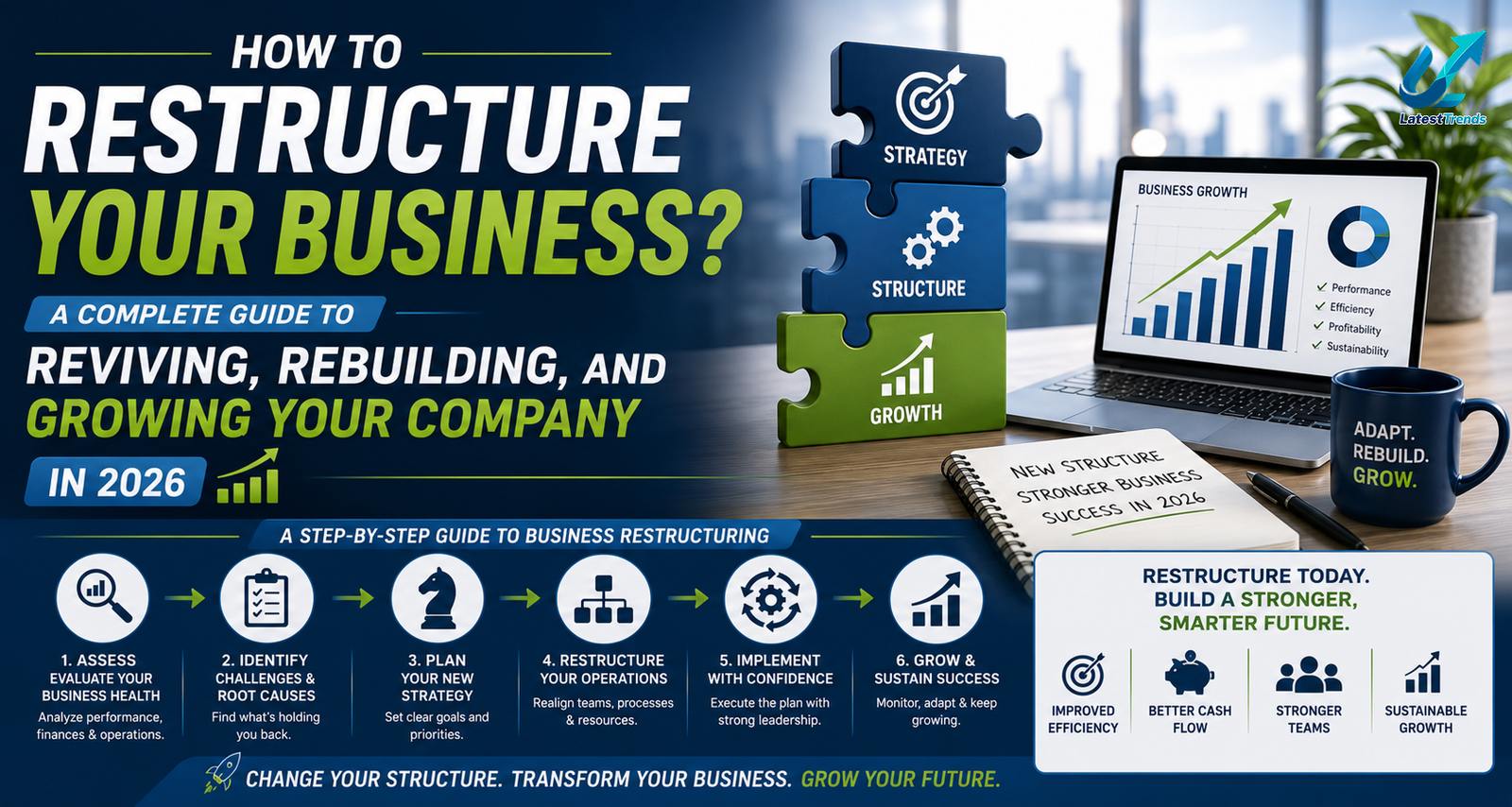
How to Restructure Your Business?
Every business goes through periods of change. A company that performed well a few years ago may suddenly face declining sales, rising costs, increased competition, or changing customer expectations. In other cases, rapid growth can expose weaknesses in operations, leadership, or financial management. When these challenges arise, restructure your Business can help restore stability and create new growth opportunities.
Contrary to popular belief, restructuring isn’t only for businesses in financial trouble. Many successful companies restructure to improve efficiency, adapt to new markets, embrace digital transformation, or prepare for expansion. A well-planned restructuring process helps businesses become leaner, stronger, and more competitive.
This guide explains everything you need to know about restructuring your business, including when to do it, how to do it successfully, common mistakes to avoid, and strategies that support long-term success.
What Is Business Restructuring?
Business restructuring is the process of reorganizing a company’s operations, finances, workforce, leadership, or business model to improve performance and achieve long-term goals.
Restructuring may involve:
- Improving operational efficiency
- Reducing unnecessary costs
- Updating the organizational structure
- Introducing new technology
- Refining products or services
- Improving customer experience
- Strengthening financial stability
- Entering new markets
The goal is to build a healthier, more sustainable business—not simply to reduce expenses.
Why Restructure Your Business Is Needed
Businesses may decide to restructure for many reasons, including:
- Declining profits
- Falling sales
- Rising operating expenses
- Cash flow challenges
- Increased competition
- Outdated business processes
- Digital disruption
- Customer behavior changes
- Rapid business expansion
- Mergers and acquisitions
Restructuring helps businesses respond proactively instead of waiting until problems become critical.
Signs It’s Time to Restructure Your Business
If your company is experiencing any of the following, restructuring may be necessary:
- Revenue has declined for several months.
- Operating costs continue to rise.
- Employee productivity has dropped.
- Customer complaints are increasing.
- Cash flow is becoming difficult to manage.
- Decision-making is slow.
- Departments work in isolation.
- Technology is outdated.
- Profit margins are shrinking.
- Your competitors are outperforming you.
Recognizing these warning signs early allows you to make improvements before they become major issues.
Benefits of Restructure Your Business
A successful restructuring plan can deliver significant long-term benefits.
These include:
- Increased profitability
- Better cash flow
- Improved productivity
- Lower operating costs
- Faster decision-making
- Better customer satisfaction
- Stronger company culture
- Greater operational flexibility
- Improved innovation
- Sustainable business growth
When done correctly, restructuring positions a business for future success rather than short-term survival.
Step-by-Step Guide to Restructure Your Business
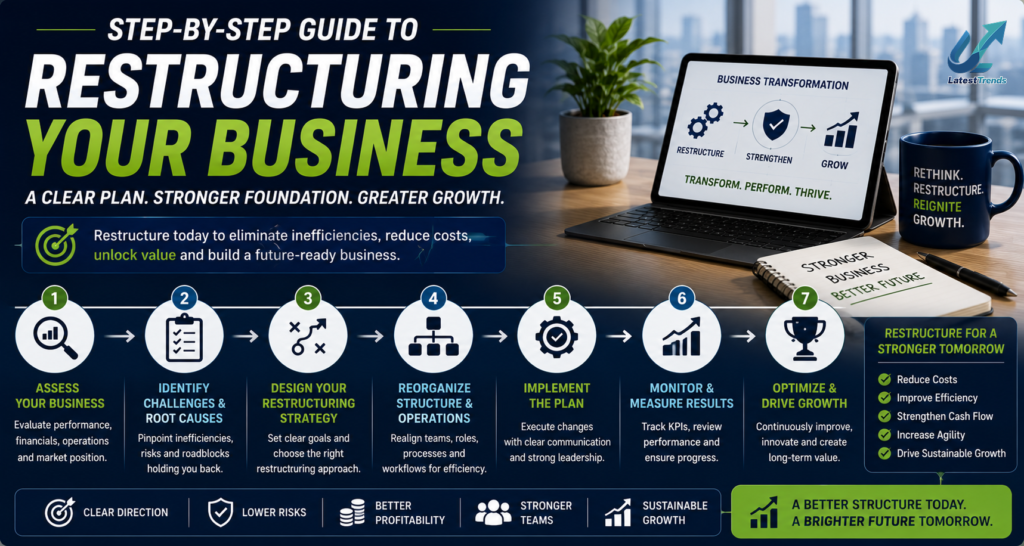
Step 1: Evaluate Your Current Business Performance
Start by understanding your current position.
Analyze:
- Revenue trends
- Profit margins
- Cash flow
- Customer satisfaction
- Employee performance
- Market share
- Operational efficiency
Use reliable financial and operational data rather than assumptions.
Step 2: Identify the Root Cause of Problems
Instead of treating symptoms, identify what’s causing poor performance.
Ask yourself:
- Why are sales declining?
- Which expenses are unnecessary?
- Which products are underperforming?
- Why are customers leaving?
- Which processes waste time?
Addressing root causes leads to lasting improvements.
Step 3: Define Clear Business Goals
Set measurable restructuring objectives such as:
- Increase revenue by 20%
- Reduce operating costs by 15%
- Improve customer retention
- Increase employee productivity
- Expand into new markets
- Improve cash flow
Clear goals help every team member understand the purpose of the restructuring process.
Step 4: Review Your Organizational Structure
As businesses grow, roles and responsibilities often become unclear.
Consider:
- Redefining leadership roles
- Eliminating duplicate responsibilities
- Improving reporting structures
- Building cross-functional teams
- Encouraging collaboration
A streamlined organization improves decision-making and accountability.
Step 5: Strengthen Financial Management
Financial restructuring is one of the most important parts of business transformation.
Focus on:
- Budget planning
- Cash flow forecasting
- Debt management
- Expense reduction
- Pricing strategy
- Profitability analysis
Healthy financial management creates stability and supports future investments.
Step 6: Improve Business Processes
Operational improvements often produce immediate results.
Look for opportunities to:
- Automate repetitive tasks
- Standardize workflows
- Reduce paperwork
- Improve inventory management
- Simplify customer support
- Increase operational efficiency
Efficient processes save time, reduce costs, and improve service quality.
Step 7: Embrace Digital Transformation
Technology has become a competitive advantage.
Consider implementing:
- Customer Relationship Management (CRM) software
- Enterprise Resource Planning (ERP) systems
- Cloud storage
- AI-powered analytics
- Marketing automation
- Accounting software
- Workflow management platforms
Technology helps businesses operate more efficiently while improving customer experiences.
Step 8: Put Customers at the Center
Successful restructuring always considers the customer.
Collect insights through:
- Customer surveys
- Online reviews
- Social media comments
- Customer support tickets
- Sales feedback
Use this information to improve products, services, and overall customer satisfaction.
Step 9: Communicate with Employees
Employees play a crucial role in successful restructuring.
Share:
- Why restructuring is necessary
- Business goals
- Expected timeline
- Individual responsibilities
- Progress updates
Transparent communication reduces uncertainty and builds trust.
Step 10: Monitor Performance Continuously
Restructuring isn’t complete after implementation.
Track Key Performance Indicators (KPIs) such as:
- Revenue growth
- Profit margins
- Customer retention
- Employee engagement
- Operational efficiency
- Net Promoter Score (NPS)
Review results regularly and adjust your strategy as needed.
Common Business Restructuring Strategies
Different businesses require different restructuring approaches.
Operational Restructuring
Improve efficiency by optimizing workflows and reducing waste.
Financial Restructuring
Strengthen cash flow, manage debt, reduce unnecessary expenses, and improve profitability.
Organizational Restructuring
Redesign departments, leadership roles, and reporting structures.
Strategic Restructuring
Refine your business model, target audience, pricing, or product portfolio.
Digital Restructuring
Adopt AI, automation, cloud technology, and data-driven decision-making to modernize operations.
Mistakes to Avoid During Business Restructuring
Avoid these common pitfalls:
- Ignoring customer feedback
- Cutting costs that reduce product quality
- Failing to communicate with employees
- Expanding before fixing internal problems
- Making decisions without reliable data
- Ignoring company culture
- Setting unrealistic timelines
- Delaying difficult decisions
- Overcomplicating workflows
- Failing to measure success
Careful planning minimizes disruption and improves results.
Leadership’s Role in Restructuring
Strong leadership is essential during periods of change.
Effective leaders:
- Communicate a clear vision
- Support employees
- Encourage innovation
- Make informed decisions
- Build accountability
- Lead by example
- Celebrate progress
Great leadership helps teams embrace change rather than resist it.
Business Restructuring Trends in 2026
Businesses are increasingly adopting:
- Artificial Intelligence (AI)
- Business automation
- Cloud-based operations
- Predictive analytics
- Hybrid work models
- Sustainable business practices
- Customer experience optimization
- Data-driven decision-making
- Low-code and no-code platforms
- Digital collaboration tools
Companies that embrace these trends are better equipped to compete in a rapidly evolving market.
Business Restructuring Checklist
Before launching your restructuring initiative, make sure you have:
- Clear business objectives
- Financial performance analysis
- Updated organizational structure
- Employee communication plan
- Customer feedback strategy
- Technology improvement roadmap
- Budget and cash flow plan
- KPI tracking system
- Risk management strategy
- Continuous improvement process
Frequently Asked Questions (FAQs)
What is business restructuring?
Business restructuring is the process of reorganizing a company’s operations, finances, leadership, or strategy to improve efficiency, profitability, and long-term sustainability.
When should a company restructure?
A company should consider restructuring when it experiences declining profits, operational inefficiencies, cash flow problems, rapid growth, or significant changes in its industry.
Does restructuring always involve layoffs?
No. Many restructuring efforts focus on improving processes, technology, leadership, and organizational efficiency without reducing the workforce.
How long does business restructuring take?
The timeline depends on the size and complexity of the business. Smaller companies may complete restructuring within a few months, while larger organizations may require a year or more.
Can restructuring improve profitability?
Yes. A successful restructuring strategy can reduce unnecessary costs, improve productivity, strengthen customer satisfaction, and increase overall profitability.
Final Thoughts
Business restructuring is not a sign of failure—it is a strategic investment in your company’s future. Markets evolve, customer expectations change, and technology advances rapidly. Businesses that regularly evaluate their operations and adapt accordingly are more likely to remain competitive and profitable.
Whether your goal is to reduce costs, improve efficiency, strengthen finances, or prepare for expansion, a well-executed restructuring plan can transform challenges into opportunities. Focus on data-driven decisions, transparent leadership, employee engagement, and customer satisfaction, and your business will be better positioned for sustainable long-term growth.