

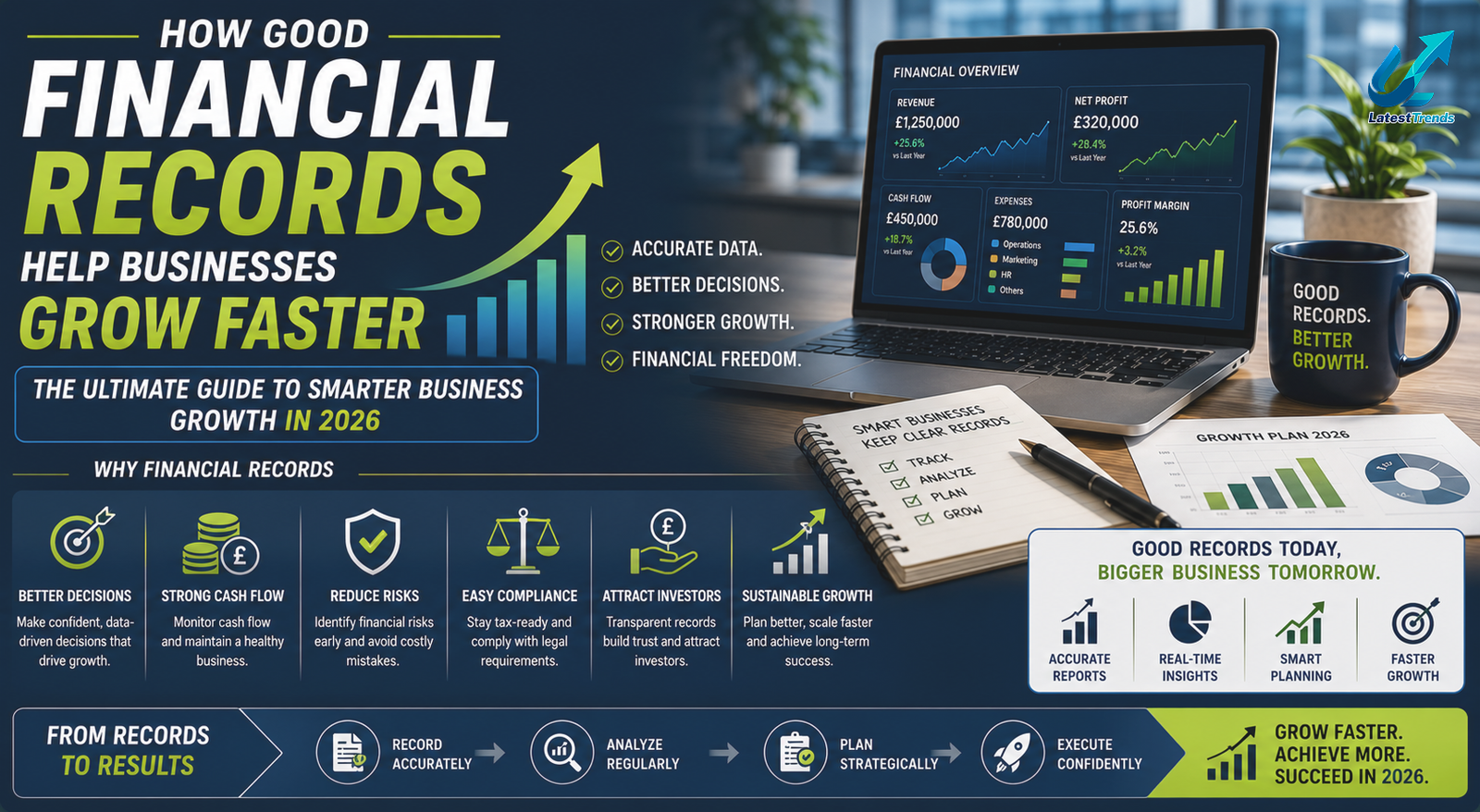
How Good Financial Records Help Businesses Grow Faster
Every successful business relies on more than great products, excellent customer service, or effective marketing. Behind every growing company is one essential element that often goes unnoticed—accurate financial records.
Many entrepreneurs focus on increasing sales and acquiring new customers while treating bookkeeping and financial reporting as routine administrative tasks. However, businesses that maintain organized financial records are often better equipped to make informed decisions, manage risks, attract investors, and scale with confidence.
Whether you’re running a startup, a small business, or a rapidly growing company, maintaining accurate financial records isn’t just about staying compliant with tax regulations—it’s about creating a roadmap for long-term success.
In this guide, you’ll learn why good financial records matter, how they accelerate business growth, common bookkeeping mistakes to avoid, and practical tips for building a financially healthy organization.
What Are Financial Records?
Financial records are documents that track every financial transaction within a business. They provide a clear picture of a company’s financial health and help business owners understand how money flows in and out of the organization.
Common financial records include:
- Income statements (Profit & Loss)
- Balance sheets
- Cash flow statements
- Sales invoices
- Purchase records
- Expense reports
- Payroll records
- Tax documents
- Bank statements
- Asset registers
- Accounts receivable reports
- Accounts payable reports
Keeping these records accurate and up to date helps businesses make smarter decisions.
Why Financial Records Matter More Than Ever
Today’s business environment is highly competitive. Rising costs, economic uncertainty, digital transformation, and changing customer expectations mean that decisions need to be backed by reliable data.
Without accurate financial records, business owners often rely on guesswork when deciding to hire employees, invest in marketing, expand into new markets, or launch new products.
Reliable financial information reduces uncertainty and gives leaders the confidence to grow strategically rather than reactively.
12 Ways Good Financial Records Help Businesses Grow Faster
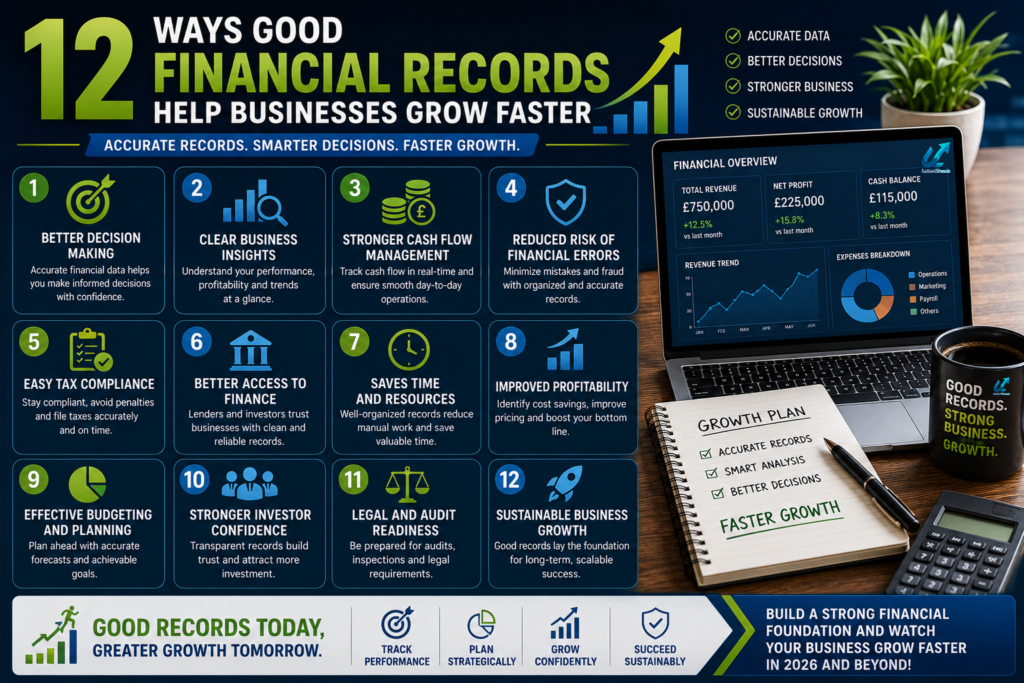
1. Better Decision-Making
Successful businesses rely on facts, not assumptions.
Accurate financial reports help answer questions such as:
- Which products generate the highest profit?
- Which services should be discontinued?
- Can the business afford to hire more employees?
- Is it the right time to expand?
- Which expenses need to be reduced?
Reliable data leads to smarter business decisions.
2. Improved Cash Flow Management
Cash flow is the lifeblood of every business.
Even profitable businesses can fail if they don’t have enough cash available to pay suppliers, employees, or operating expenses.
Financial records help monitor:
- Incoming payments
- Outstanding invoices
- Operating expenses
- Loan repayments
- Monthly cash flow
- Emergency reserves
Managing cash flow effectively supports sustainable growth.
3. Easier Budget Planning
A realistic budget begins with accurate historical financial data.
Good records allow businesses to:
- Forecast revenue
- Estimate expenses
- Allocate resources wisely
- Avoid overspending
- Plan future investments
Budgets become more accurate when supported by reliable financial information.
4. Increased Investor Confidence
Investors and lenders want evidence—not assumptions.
Before investing, they typically review:
- Revenue trends
- Profit margins
- Cash flow reports
- Financial forecasts
- Debt obligations
- Business performance metrics
Organized financial records demonstrate professionalism and improve funding opportunities.
5. Faster Tax Filing
Tax season becomes significantly easier when financial records are organized throughout the year.
Benefits include:
- Faster tax preparation
- Reduced accounting costs
- Lower risk of penalties
- Accurate tax reporting
- Better audit readiness
Good bookkeeping saves both time and money.
6. Stronger Cost Control
Businesses often lose money through unnoticed spending.
Detailed financial records help identify:
- Unnecessary subscriptions
- High operating expenses
- Wasteful purchasing
- Low-performing investments
- Increasing supplier costs
Reducing unnecessary expenses improves profitability.
7. Better Business Forecasting
Historical financial data helps predict future performance.
Businesses can estimate:
- Sales growth
- Seasonal demand
- Hiring needs
- Inventory requirements
- Marketing budgets
- Capital investments
Forecasting allows companies to prepare instead of reacting to challenges.
8. Improved Customer Credit Management
Businesses that offer credit need accurate records to monitor payments.
Tracking accounts receivable helps:
- Reduce overdue invoices
- Improve collections
- Strengthen cash flow
- Identify payment risks
- Build healthier customer relationships
Timely collections improve overall financial stability.
9. Easier Loan Approvals
Banks and financial institutions evaluate financial records before approving loans.
Lenders often review:
- Income statements
- Balance sheets
- Cash flow reports
- Tax returns
- Business performance history
Well-maintained records increase credibility and improve financing opportunities.
10. Better Risk Management
Financial records help businesses identify risks before they become major problems.
Examples include:
- Declining sales
- Shrinking profit margins
- Rising expenses
- Cash shortages
- Customer payment delays
Early detection allows businesses to take corrective action quickly.
11. More Efficient Business Operations
Financial records often reveal operational inefficiencies.
Businesses can identify:
- Slow-moving inventory
- Inefficient departments
- Unprofitable services
- Resource waste
- Workflow bottlenecks
Improving efficiency increases productivity and profitability.
12. Sustainable Long-Term Growth
Businesses that maintain strong financial discipline are better prepared for:
- Expansion
- Hiring
- Product launches
- International growth
- Strategic partnerships
- Acquisitions
Growth supported by accurate financial information is more sustainable than growth driven by guesswork.
Essential Financial Reports Every Business Should Review
Reviewing reports regularly helps maintain financial health.
Profit and Loss Statement
Shows revenue, expenses, and overall profitability.
Balance Sheet
Provides a snapshot of assets, liabilities, and owner’s equity.
Cash Flow Statement
Tracks how money enters and leaves the business.
Accounts Receivable Report
Shows customer payments that are still outstanding.
Accounts Payable Report
Tracks amounts owed to suppliers and vendors.
Budget vs. Actual Report
Compares planned spending with actual results.
Common Financial Record-Keeping Mistakes
Avoid these common errors:
- Mixing personal and business expenses
- Delaying bookkeeping
- Losing receipts
- Ignoring cash flow reports
- Not reconciling bank accounts
- Incorrect expense categorization
- Failing to back up financial data
- Ignoring overdue invoices
- Not reviewing reports monthly
- Relying only on spreadsheets without proper controls
Correcting these habits early prevents larger financial problems.
Best Practices for Maintaining Financial Records
Successful businesses follow consistent financial routines.
Recommended practices include:
- Record transactions daily or weekly.
- Use cloud-based accounting software.
- Keep digital copies of invoices and receipts.
- Reconcile bank accounts every month.
- Separate personal and business finances.
- Review financial reports regularly.
- Set monthly budgets.
- Monitor key performance indicators (KPIs).
- Work with a qualified accountant when needed.
- Protect financial data with secure backups.
Consistency is more important than complexity.
Financial Metrics Every Business Owner Should Track
Monitoring the right metrics provides valuable insight into business performance.
Important KPIs include:
- Revenue Growth Rate
- Gross Profit Margin
- Net Profit Margin
- Operating Margin
- Cash Flow
- Customer Acquisition Cost (CAC)
- Customer Lifetime Value (LTV)
- Accounts Receivable Turnover
- Current Ratio
- Debt-to-Equity Ratio
- Inventory Turnover
- Return on Investment (ROI)
Tracking these metrics monthly helps businesses identify opportunities for improvement.
Modern Technology Makes Financial Management Easier
Today’s businesses have access to powerful digital tools that simplify bookkeeping and reporting.
Popular solutions include:
- Cloud accounting software
- AI-powered bookkeeping
- Expense management applications
- Payroll automation
- Invoice automation
- Digital payment systems
- Business intelligence dashboards
- Financial forecasting software
Technology reduces manual work while improving accuracy.
Financial Management Trends in 2026
Businesses are increasingly adopting:
- AI-powered accounting assistants
- Automated expense tracking
- Real-time financial dashboards
- Predictive cash flow forecasting
- Paperless accounting
- Cloud-based finance systems
- Digital tax compliance
- Business analytics powered by AI
- Automated invoice processing
- Integrated financial reporting
Companies embracing these innovations often make faster and more informed financial decisions.
Financial Record-Keeping Checklist
Before planning your next stage of growth, ensure your business has:
- Organized bookkeeping system
- Monthly Profit & Loss reports
- Updated Balance Sheet
- Cash Flow Statement
- Bank reconciliations completed
- Tax records organized
- Expense tracking system
- Accounts receivable monitoring
- Financial KPI dashboard
- Secure backup of financial records
Frequently Asked Questions (FAQs)
Why are financial records important for business growth?
Financial records provide accurate information about income, expenses, cash flow, and profitability. They help business owners make informed decisions, control costs, and identify opportunities for growth.
How often should financial records be updated?
Ideally, transactions should be recorded daily or weekly, with key financial reports reviewed at least once a month.
Can good financial records help secure investment?
Yes. Investors and lenders typically require organized financial statements to assess the health and potential of a business before providing funding.
What’s the biggest bookkeeping mistake small businesses make?
One of the most common mistakes is mixing personal and business finances, which makes financial reporting and tax preparation more difficult.
Do small businesses need accounting software?
While it’s possible to manage finances manually, accounting software improves accuracy, saves time, and simplifies reporting as a business grows.
Final Thoughts
Good financial records are far more than a legal requirement—they are a strategic advantage. Businesses that maintain accurate, organized, and up-to-date financial information are better equipped to manage cash flow, make confident decisions, attract investors, secure financing, and adapt to changing market conditions.
Rather than viewing bookkeeping as an administrative task, successful entrepreneurs treat it as a powerful business tool. Every invoice, receipt, and financial report contributes to a clearer understanding of the company’s performance and future potential.
Whether you’re launching a startup or managing an established company, investing in strong financial record-keeping today can accelerate growth, improve profitability, and build a more resilient business for tomorrow.