

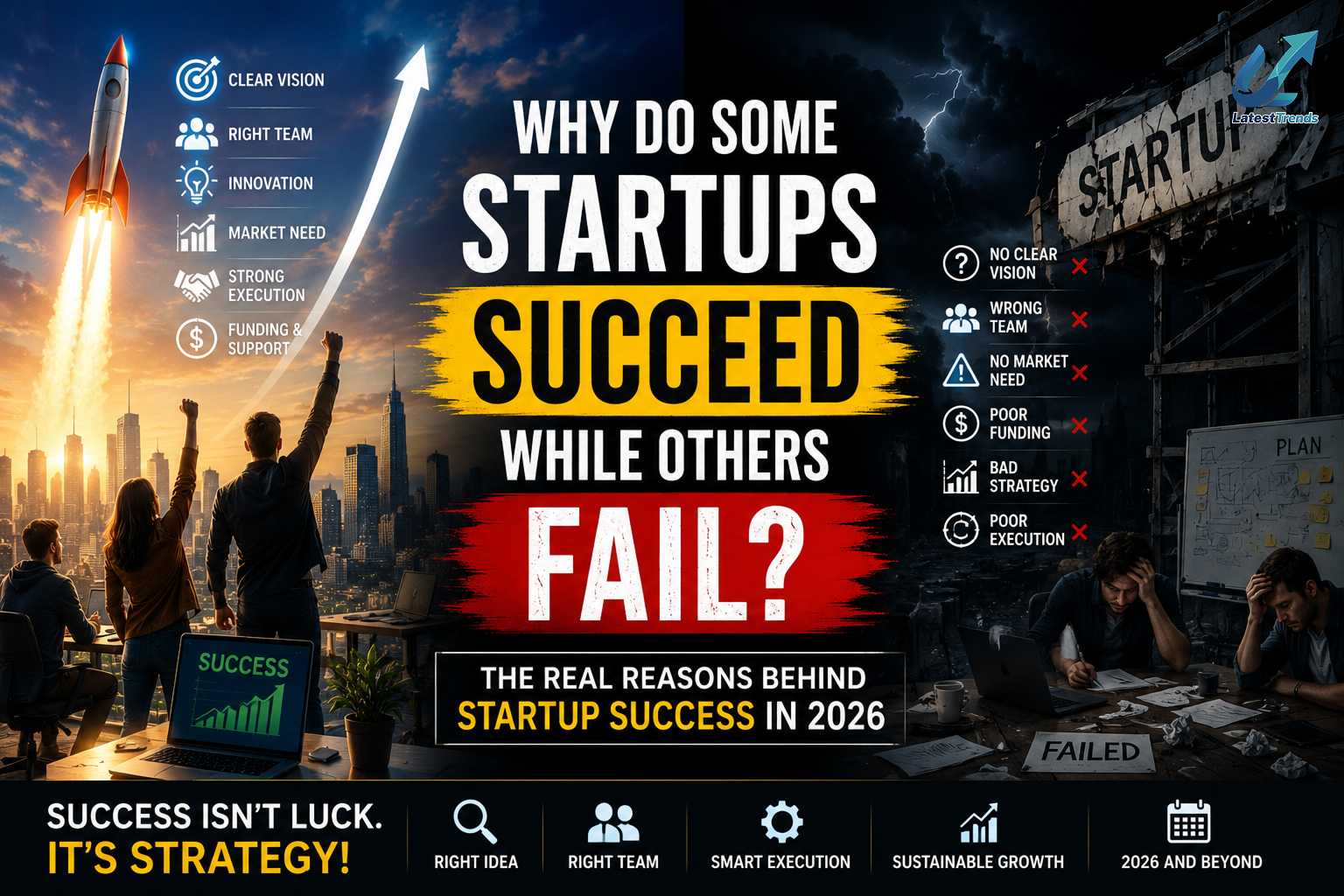
Why Do Some Startups Succeed While Others Fail?
Launching a startup is one of the most exciting journeys an entrepreneur can take. Every year, millions of people turn innovative ideas into businesses with hopes of becoming the next unicorn. However, the harsh reality is that many startups never survive beyond their first few years.
So what separates successful startups from failed ones?
Is it luck? Funding? Timing? Or something much deeper?
The truth is that startup success depends on a combination of vision, execution, adaptability, leadership, customer understanding, and financial discipline. In this guide, we’ll explore the biggest reasons why some startups thrive while others disappear, backed by practical insights that every entrepreneur should know.
Startup Success Statistics
The startup ecosystem is full of opportunities, but it is also highly competitive.
Some eye-opening statistics include:
- Around 90% of startups eventually fail.
- Nearly 20% fail during their first year.
- More than half close within five years.
- Startups that solve genuine customer problems have significantly higher survival rates.
- Companies with strong product-market fit grow much faster than those chasing trends.
These numbers might seem discouraging, but they also reveal an important lesson: success is possible when founders avoid common mistakes.
Why Startups Succeed
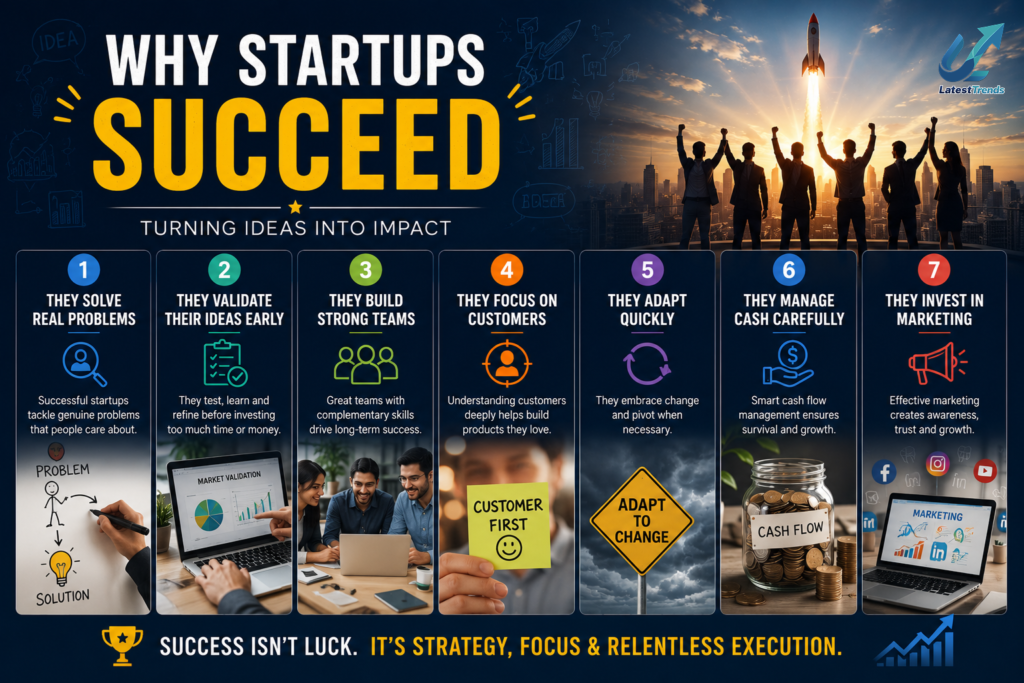
1. They Solve Real Problems
The most successful startups don’t begin with technology—they begin with a problem.
Customers don’t buy products because they’re innovative; they buy solutions that improve their lives.
Successful founders spend countless hours understanding customer pain points before building their product.
Ask yourself:
- Does my product solve a genuine problem?
- Are customers willing to pay for this solution?
- Can I clearly explain the value in one sentence?
Businesses built around meaningful solutions naturally attract loyal customers.
2. They Validate Their Ideas Early
Many entrepreneurs spend months or years developing products without speaking to potential customers.
Successful startups take the opposite approach.
Instead of building everything at once, they create a Minimum Viable Product (MVP), gather feedback, and improve continuously.
Benefits include:
- Lower development costs
- Faster learning
- Reduced business risk
- Better customer satisfaction
Validation saves both money and time.
3. They Build Strong Teams
Behind every successful startup is a dedicated team.
Great founders hire people who complement their skills rather than duplicate them.
Winning teams usually have expertise in:
- Product Development
- Marketing
- Sales
- Finance
- Customer Support
- Technology
Strong communication and shared vision often matter more than experience alone.
4. They Focus on Customers
Customer-centric companies consistently outperform competitors.
Successful startups:
- Listen to customer feedback
- Improve products regularly
- Respond quickly to complaints
- Build long-term relationships
Happy customers become repeat buyers and recommend businesses to others, reducing marketing costs.
5. They Adapt Quickly
Markets change rapidly. Consumer preferences evolve. Technology advances. Successful startups don’t resist change—they embrace it. Instead of sticking rigidly to the original business plan, they pivot when necessary and continuously improve their products.
Flexibility often determines survival.
6. They Manage Cash Carefully
Many startups don’t fail because of bad ideas.
They fail because they run out of money.
Smart founders:
- Track expenses carefully
- Avoid unnecessary hiring
- Maintain emergency reserves
- Focus on sustainable growth
Cash flow is the lifeblood of every startup.
7. They Invest in Marketing
Even the best product won’t succeed if nobody knows it exists.
Winning startups build marketing into their strategy from day one.
Popular channels include:
- SEO
- Content Marketing
- Email Marketing
- Social Media
- Influencer Marketing
- Video Marketing
- Paid Advertising
- Referral Programs
Visibility drives growth.
Why Startups Fail
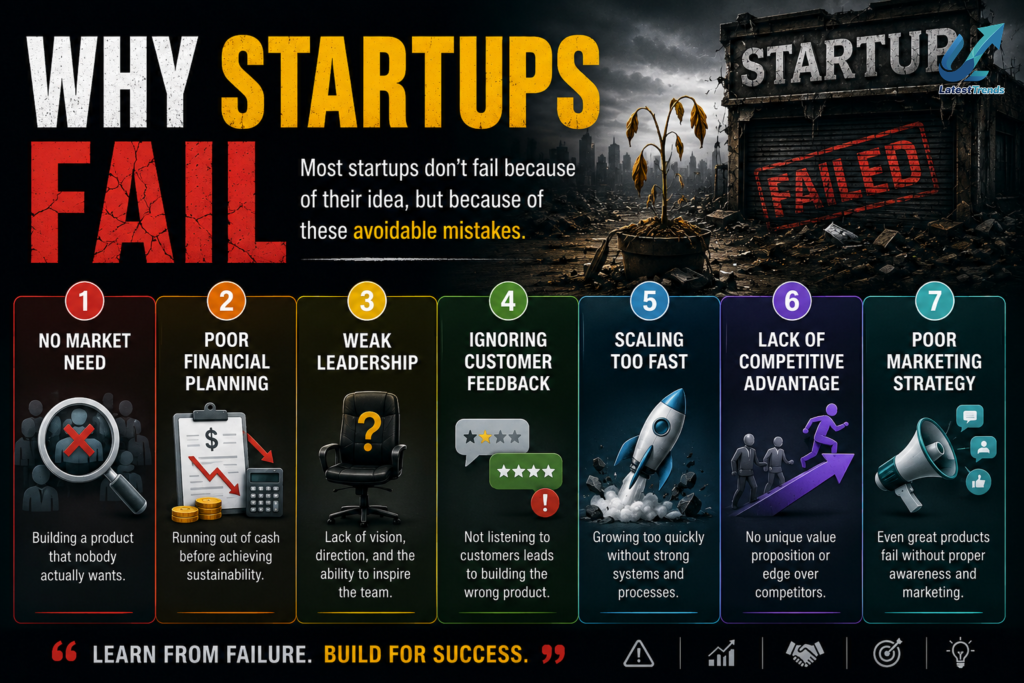
1. No Market Need
The number one reason startups fail is simple:
Nobody wants the product.
Many founders build solutions searching for problems instead of solving existing ones.
Market research should always come first.
2. Poor Financial Planning
Overspending is a common mistake.
Examples include:
- Expensive office spaces
- Unnecessary software
- Excessive hiring
- High advertising costs without measurable returns
Financial discipline is essential.
3. Weak Leadership
Leadership determines company culture.
Poor decision-making can lead to:
- Employee turnover
- Investor concerns
- Customer dissatisfaction
- Slow execution
Strong leaders inspire confidence and maintain focus.
4. Ignoring Customer Feedback
Customers often reveal exactly what needs improvement.
Ignoring reviews, complaints, or suggestions allows competitors to capture dissatisfied users.
Feedback is free market research.
5. Scaling Too Fast
Growth is exciting—but premature scaling is dangerous.
Hiring large teams or expanding internationally before achieving stable revenue often creates unsustainable expenses.
Grow only after proving your business model.
6. Lack of Competitive Advantage
If customers can easily replace your product with another, growth becomes difficult.
Successful startups differentiate through:
- Better quality
- Lower prices
- Superior customer service
- Faster delivery
- Innovation
- Brand trust
Differentiation creates long-term value.
7. Poor Marketing Strategy
Many founders assume a great product will “sell itself.”
Unfortunately, that rarely happens.
Without visibility, even exceptional products struggle.
Consistent content creation, SEO, branding, and customer engagement are essential.
Characteristics of Successful Startup Founders
Successful entrepreneurs often share these qualities:
- Visionary thinking
- Problem-solving mindset
- Persistence
- Emotional resilience
- Strong communication
- Data-driven decision-making
- Willingness to learn
- Customer obsession
- Adaptability
- Financial awareness
These habits are often more valuable than technical expertise alone.
Startup Success Checklist
Before launching your startup, ask yourself:
- Does my product solve a real problem?
- Have I spoken to potential customers?
- Is there a clear revenue model?
- Do I understand my competition?
- Is my marketing strategy ready?
- Do I have enough financial runway?
- Can my business scale sustainably?
The more “Yes” answers you have, the stronger your foundation.
Emerging Startup Trends in 2026
Entrepreneurs who align with growing industries have additional opportunities.
Trending sectors include:
- Artificial Intelligence (AI)
- Healthcare Technology
- Climate and Clean Energy
- Cybersecurity
- FinTech
- EdTech
- Creator Economy Tools
- SaaS Platforms
- Robotics and Automation
- Sustainable Consumer Products
While trends can create opportunities, solving a real customer problem remains more important than chasing hype.
Lessons from Successful Startups
Companies that achieve lasting success often share common practices:
- They started small and improved continuously.
- They prioritized customer feedback over assumptions.
- They built sustainable business models.
- They treated failures as learning opportunities.
- They focused on long-term value rather than short-term hype.
- They created strong company cultures.
- They stayed disciplined with spending and measured growth carefully.
These principles apply whether you’re building a local business or a global technology company.
Frequently Asked Questions (FAQs)
Why do most startups fail?
Most startups fail because they don’t solve a real customer problem, run out of cash, or struggle to find product-market fit.
What is the biggest reason startups succeed?
A strong product that solves a genuine customer need, combined with disciplined execution, customer focus, and financial management.
Is funding the most important factor?
No. Funding helps, but many well-funded startups fail. Sustainable growth, execution, and customer value matter more.
How long does it take for a startup to become profitable?
It varies by industry. Some startups become profitable within one to three years, while others prioritize growth before profitability.
Can a failed startup founder succeed later?
Absolutely. Many successful entrepreneurs experienced one or more failed ventures before building thriving companies. Lessons learned from failure often become valuable assets.
Final Thoughts
Every successful startup begins with an idea, but ideas alone are never enough. The companies that endure are those that remain focused on solving meaningful problems, listening to customers, managing resources wisely, and adapting as markets evolve.
Failure is not always the end—it can be an essential step toward building a stronger business. By learning from the common reasons startups struggle and applying proven principles of success, entrepreneurs can dramatically improve their chances of creating sustainable, high-growth companies.
Whether you’re launching your first venture or scaling an existing one, remember that consistent execution, customer trust, and continuous learning are the true foundations of long-term startup success.








One Comment