

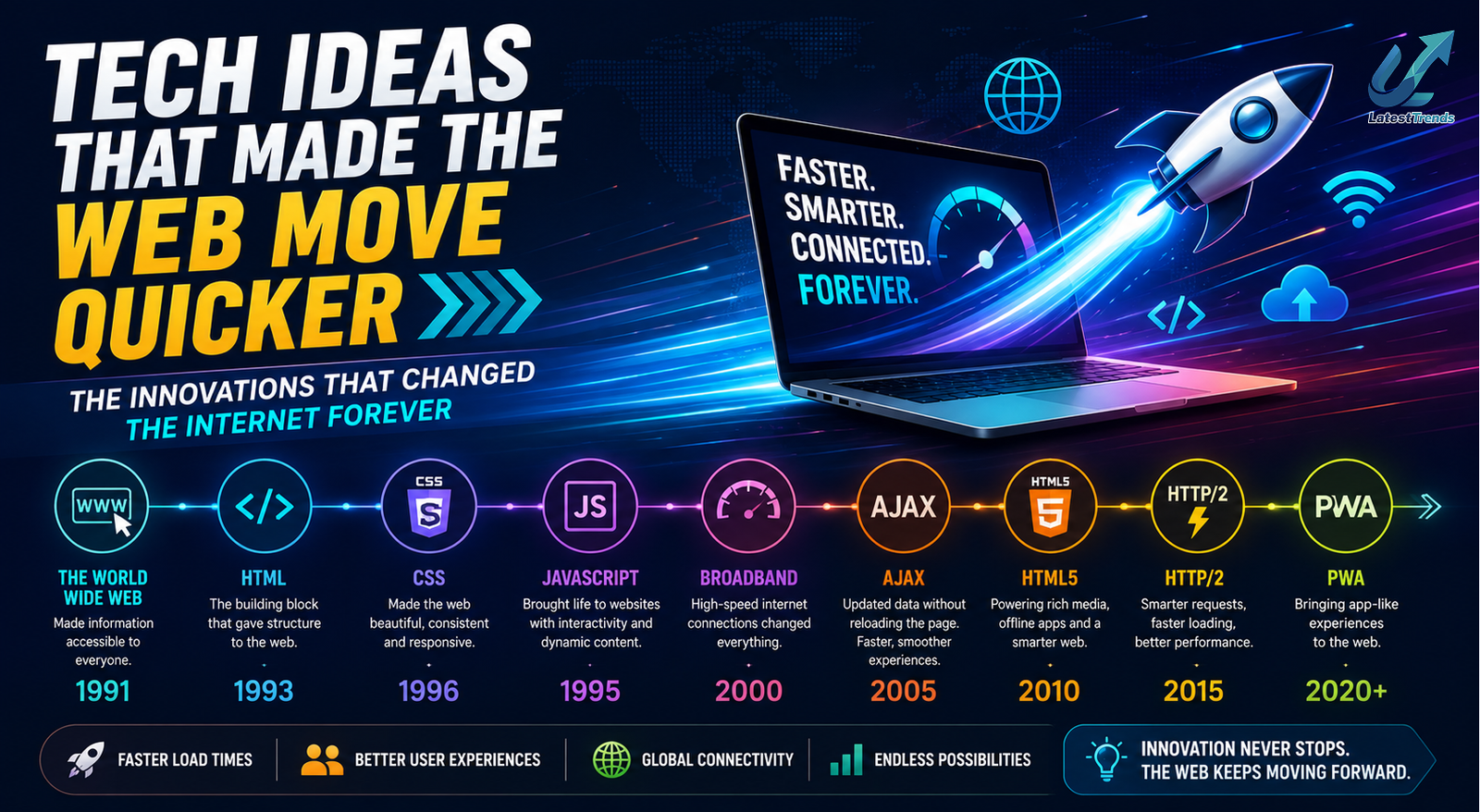
Tech Ideas That Made the Web Move Quicker
The internet has transformed dramatically over the past three decades. In the early days, opening a single webpage often meant waiting several minutes while images slowly appeared line by line. Today, websites, videos, games, and cloud applications load almost instantly thanks to tech ideas. This incredible improvement wasn’t the result of one invention—it came from a combination of revolutionary technologies that made the web significantly faster, smarter, and more efficient.
Whether you’re streaming a 4K movie, attending a virtual meeting, shopping online, or using AI-powered tools, you’re benefiting from innovations that quietly work behind the scenes every second.
1. Broadband Internet Replaced Dial-Up
One of the biggest milestones in internet history was the shift from dial-up connections to broadband.
Dial-up connections used telephone lines and typically offered speeds below 56 Kbps. Downloading a single song could take several minutes, while videos were almost impossible to watch online.
Broadband introduced always-on connectivity with dramatically higher speeds. DSL, cable internet, and later fiber optics allowed users to browse multiple websites, download large files, and stream media without constant interruptions.
This single innovation changed how people used the internet and paved the way for modern web applications.
2. Fiber Optic Networks Changed Everything
Fiber optic cables transmit data using pulses of light instead of electrical signals.
Compared to traditional copper cables, fiber offers:
- Gigabit internet speeds
- Lower latency
- Higher reliability
- Better performance over long distances
- Greater bandwidth for millions of simultaneous users
Today, fiber infrastructure powers data centers, businesses, schools, hospitals, and millions of homes worldwide.
3. Content Delivery Networks (CDNs)
Imagine visiting a website hosted in another country, tech ideas.
Without a CDN, your request would travel thousands of kilometers before reaching the server.
A Content Delivery Network (CDN) solves this problem by storing copies of website content on servers located around the world. When someone visits the website, the content is delivered from the nearest server instead of the original one.
Benefits include:
- Faster page loading
- Reduced server load
- Improved reliability
- Better security
- Lower latency
Popular websites like streaming platforms, e-commerce stores, and news portals rely heavily on CDNs to serve millions of users efficiently.
4. Browser Caching Reduces Repeat Downloads
Modern browsers remember previously downloaded resources such as:
- Images
- CSS files
- JavaScript
- Fonts
- Icons
Instead of downloading these files every time a user visits a website, browsers load them from local storage.
This simple idea dramatically reduces loading times and saves internet bandwidth.
5. Better Compression Algorithms
Large files once slowed websites significantly.
Modern compression technologies reduce file sizes without noticeably affecting quality.
Examples include:
- Gzip
- Brotli
- Image compression
- Video compression
- Modern image formats like WebP and AVIF
Smaller files travel faster across networks, resulting in noticeably quicker page loads.
6. Faster Internet Protocols
The protocols that power the web have evolved continuously.
HTTP/1.1
The original standard required multiple connections for loading different website resources.
HTTP/2
Introduced multiplexing, allowing multiple files to travel simultaneously over a single connection.
HTTP/3
Built on the QUIC transport protocol, HTTP/3 offers:
- Lower latency
- Faster secure connections
- Improved performance on unstable networks
- Better mobile browsing experiences
This upgrade significantly speeds up modern websites.
7. Cloud Computing Revolutionized Website Hosting
Previously, websites depended on a single physical server.
Cloud computing changed this by distributing workloads across many servers located in different regions.
Advantages include:
- Automatic scaling
- High availability
- Better uptime
- Faster global performance
- Improved disaster recovery
Businesses can now handle sudden traffic spikes without slowing down.
8. Edge Computing Brings Data Closer
Instead of sending every request to a distant cloud server, edge computing processes information closer to users.
This reduces:
- Delay
- Network congestion
- Response time
Edge computing is especially valuable for:
- Online gaming
- Self-driving cars
- Smart cities
- IoT devices
- Live streaming
- AI applications
9. Smarter DNS Systems
Before loading a website, browsers must find the server’s IP address.
Modern DNS providers use intelligent routing and global networks to resolve these requests in milliseconds.
Popular public DNS services also improve:
- Security
- Reliability
- Speed
- Website availability
Even small improvements in DNS lookup time contribute to faster browsing.
10. Website Optimization Techniques
Developers continuously optimize websites using techniques such as:
- Lazy loading
- Image optimization
- Code minification
- JavaScript optimization
- CSS optimization
- Database optimization
- Asynchronous loading
- Server-side rendering
These improvements may seem minor individually, but together they significantly enhance user experience.
11. Mobile Networks Evolved From 2G to 5G
Mobile internet has undergone an extraordinary transformation.
2G
Basic text browsing.
3G
Introduced mobile web browsing and video calls.
4G LTE
Enabled HD streaming and high-speed downloads.
5G
Provides:
- Ultra-low latency
- Multi-gigabit speeds
- Faster cloud gaming
- Better AR/VR experiences
- Improved smart device connectivity
5G continues to reshape mobile internet performance.
12. Artificial Intelligence Optimizes the Web
Artificial Intelligence has become an invisible engine behind faster web experiences.
AI helps by:
- Predicting user behavior
- Optimizing website resources
- Managing network traffic
- Detecting cyber threats
- Compressing media efficiently
- Improving search algorithms
- Automating content delivery
Many leading websites now use AI to reduce loading times and enhance user satisfaction.
13. Faster Web Browsers
Modern browsers such as Google Chrome, Microsoft Edge, Mozilla Firefox, Safari, and Brave include powerful rendering engines that execute web code more efficiently than ever before.
New browser technologies include:
- Hardware acceleration
- Improved JavaScript engines
- Better memory management
- Background tab optimization
- Energy-efficient processing
These improvements make today’s browsing experience noticeably smoother.
14. The Rise of Progressive Web Apps (PWAs)
Progressive Web Apps combine the best features of websites and native mobile apps.
PWAs can:
- Load quickly
- Work offline
- Send notifications
- Install without an app store
- Consume fewer device resources
They provide a fast and reliable experience, especially in areas with slower internet connections.
15. Data Centers Became More Efficient
Modern hyperscale data centers are engineered for speed and resilience. Faster storage systems such as NVMe SSDs, advanced networking hardware, intelligent cooling, and automation allow services to respond to user requests almost instantly. Combined with renewable energy initiatives and AI-driven resource management, today’s data centers are both faster and more sustainable than earlier generations.
How These Technologies Work Together
No single innovation made today’s internet incredibly fast. Instead, they complement each other:
- Fiber optic networks move massive amounts of data.
- CDNs deliver content from nearby servers.
- HTTP/3 reduces connection delays.
- Cloud and edge computing process requests efficiently.
- Browser caching avoids unnecessary downloads.
- AI continuously optimizes traffic and performance.
- Compression minimizes file sizes.
- Modern browsers render pages faster.
Together, these technologies create the seamless online experiences people expect every day.
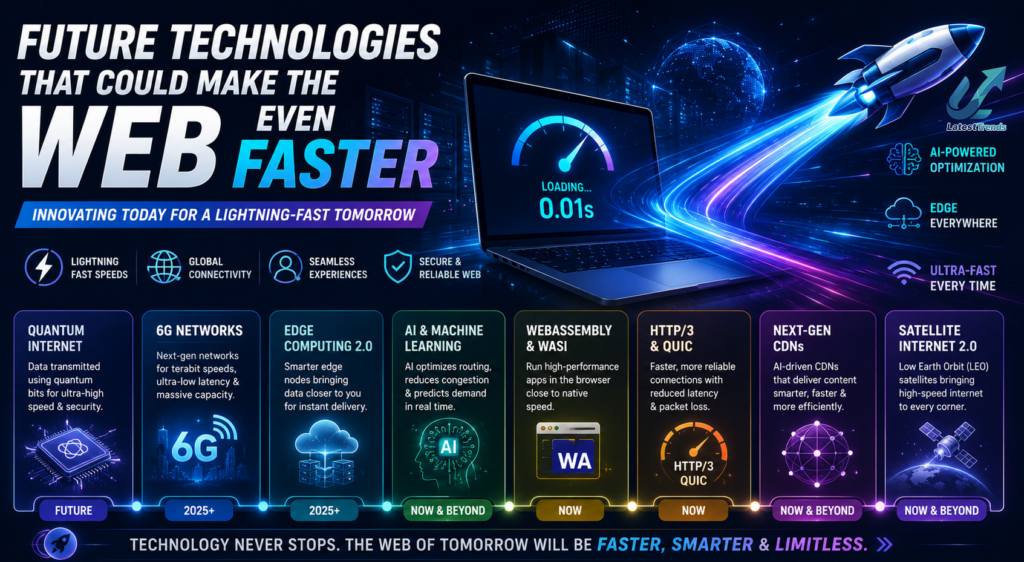
Future Technologies That Could Make the Web Even Faster
The next wave of innovation is already underway. Technologies such as 6G, quantum networking research, AI-powered network optimization, satellite internet constellations, photonic computing, and advanced edge AI could further reduce latency and expand high-speed connectivity to remote regions.
As digital experiences become more immersive—with augmented reality, virtual reality, and real-time AI assistants—the demand for faster and more reliable internet will continue to grow.
Final Thoughts
The web has evolved from slow dial-up connections to an intelligent, globally connected ecosystem capable of delivering information in fractions of a second. Innovations like broadband, fiber optics, CDNs, cloud computing, HTTP/3, browser optimization, AI, and 5G have fundamentally changed how we communicate, work, learn, and entertain ourselves.
As new technologies emerge, the internet will become even more responsive, secure, and accessible. Understanding the ideas behind these improvements not only highlights the remarkable progress of the digital age but also offers a glimpse into the exciting future of the web.
Frequently Asked Questions (FAQs)
What technology had the biggest impact on internet speed?
Broadband internet and fiber optic networks had the most significant impact, enabling high-speed connectivity for homes and businesses worldwide.
What is a CDN, and why is it important?
A Content Delivery Network (CDN) stores website content on multiple servers around the world so users receive data from the nearest location, improving speed and reliability.
How does HTTP/3 improve web performance?
HTTP/3 reduces latency, establishes connections more quickly, and performs better on unstable or mobile networks than previous HTTP versions.
Why is AI important for faster websites?
AI helps optimize traffic, compress content, predict user behavior, enhance security, and improve overall website performance in real time.
What role does edge computing play?
Edge computing processes data closer to users, reducing delays and improving responsiveness for applications such as gaming, streaming, IoT, and AI services.